Why High-Performing Teams Still Struggle: Building Team Trust That Lasts
It’s Not Capability, It’s Trust
More often than not, when teams struggle, it is not because people do not know how to do their jobs. The skills are there. The experience is there. On paper, the team may even look exceptionally strong.
What begins to weaken is something harder to see: trust.
At first glance, everything may seem fine. Tasks are getting done, meetings are happening on time, and communication appears cordial. But beneath the surface, people may be editing themselves. They nod in agreement during discussions but privately disagree. Team members hesitate to challenge each other’s ideas. Feedback becomes less frequent, and uncomfortable conversations are replaced by polite silence.
The team is still functioning, but it is becoming more cautious.
This is why building team trust should not begin only after performance declines. It needs to be part of how teams communicate, make decisions and take responsibility every day.
What Building Team Trust Really Means
Building team trust is not about creating a team where everyone agrees or where difficult conversations disappear.
In fact, trust often becomes most visible when disagreement happens.
A high-trust team can challenge an idea without attacking the person behind it. People can ask for help without worrying that it makes them look incapable. Leaders can admit they do not have every answer, and team members can give difficult feedback because there is enough confidence in the relationship to have an honest conversation.
Teams need this trust most when pressure increases, priorities change, targets are missed or decisions become difficult.
Without trust, people begin protecting themselves. With trust, they are more likely to focus on solving the problem in front of them.
Trust Doesn’t Break Loudly. It Disappears Quietly.
Trust rarely collapses in one dramatic moment. More often, it weakens through ordinary interactions.
A difficult conversation gets postponed. Someone decides not to raise a concern because the last one was dismissed too quickly. A team member stops offering ideas after repeatedly being interrupted. A manager asks for ownership but steps in and takes control whenever something goes wrong.
Individually, these moments may appear insignificant. Together, they teach people how safe it is to contribute honestly.
That is what makes low trust difficult to detect. Meetings still happen. Reports still get submitted. People remain polite.
But politeness and trust are not the same thing.
A team may appear harmonious simply because people have learned that disagreement is not worth the effort. When that happens, leaders gradually lose access to information, ideas and concerns that could have improved a decision or prevented a problem.
What Actually Rebuilds Trust?
Trust is rebuilt through small but consistent behaviours.
It happens when a teammate says what they genuinely think instead of agreeing to avoid tension. It happens when a leader admits a mistake without shifting responsibility. It happens when someone receives difficult feedback with curiosity instead of immediately becoming defensive.
Repeated over time, these moments change what a team learns about itself. People begin to understand that speaking up is possible, disagreement does not automatically damage relationships, accountability does not always mean blame, and asking for help does not make someone less capable.
This is why building team trust cannot be reduced to a one-day outing, motivational session or set of team games.
Those experiences may create awareness, but trust is strengthened by what happens afterwards: how leaders respond when challenged, how teams handle conflict, whether commitments are honoured and what happens when pressure returns.
Trust is built through patterns, not isolated moments.
Making Team Behaviour Visible
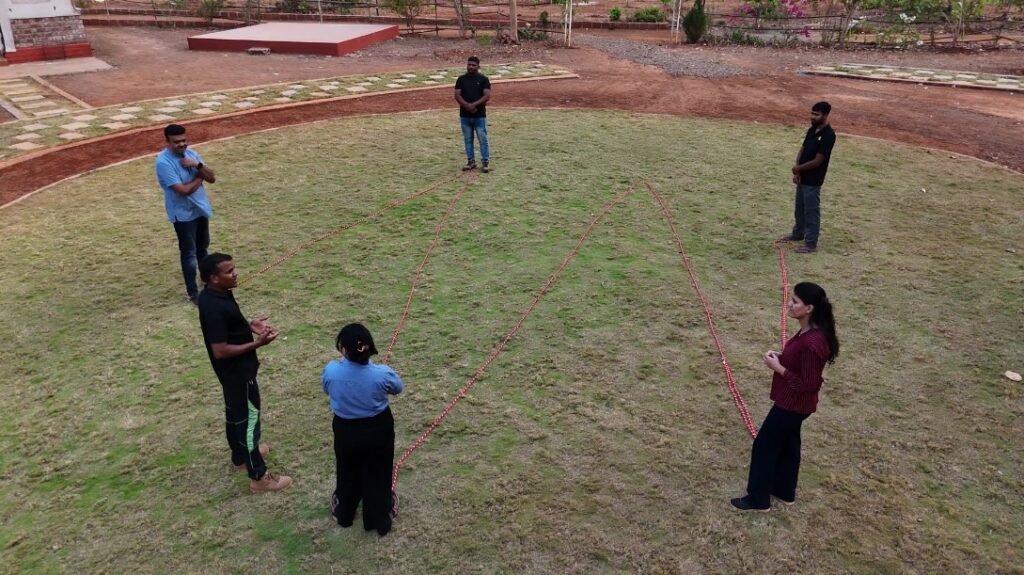
This is where a well-designed team intervention can become valuable.
At Mustardseed Training, we do not see team-building activities as the end outcome. An activity is useful when it reveals something about how the team actually behaves.
Who steps forward when the answer is unclear? Who withdraws? Does the team listen to different viewpoints or quickly follow the strongest voice? Does one person take over when pressure increases? Can people challenge a plan when they believe it is not working?
These patterns often become easier to observe in an experiential environment because participants are responding in real time rather than discussing teamwork in theory.
The important part comes afterwards: connecting what happened back to work.
The person who takes control during an activity may also struggle to delegate in the workplace. The team that overlooks a quieter participant may be missing useful perspectives in meetings. A group that waits for one person to make every decision may be showing the same dependence that slows execution back at work.
The purpose is not to label these behaviours as good or bad. It is to make them visible enough to examine.
Once teams can see their own patterns, they can begin asking better questions: Where else does this happen? What does it cost us? What would we need to do differently?
That is where team building moves beyond engagement and starts becoming a behavioural intervention.
Mustardseed’s Team Building Training follows this principle. The objective is not simply to create a memorable experience, but to strengthen behaviours that improve collaboration, ownership and the way teams perform together.
From Team Trust to Business Performance
Trust may sound like a people issue, but its consequences are operational.
When people hesitate to raise concerns, problems surface later. When team members do not trust each other’s judgement, decisions move unnecessarily upward. When leaders ask people to take ownership but repeatedly override them, employees learn to wait rather than act.
Over time, managers become bottlenecks. Decisions slow down. Collaboration becomes harder, and capable employees spend more energy protecting themselves than solving problems.
This is why building team trust is not separate from performance; it shapes how effectively a team can execute.
Trust influences whether information moves quickly through a team, whether weak ideas are challenged before they become costly decisions, and whether responsibility can be distributed rather than concentrated with a few individuals.
For organisations, the goal should therefore not simply be to create teams that “get along.”
The goal is to create teams that can work honestly and effectively together, particularly when the work becomes difficult.
When team behaviour affects decision-making, ownership, collaboration and execution, trust becomes more than an engagement issue. It becomes a business performance issue.
What Happens After the Intervention Matters Most
An intervention can create awareness, but awareness alone is not enough. The real test comes later: how does a leader respond the next time someone disagrees? Does the team address a difficult issue or quietly move past it? Are people genuinely trusted with responsibility, or is that responsibility taken back at the first sign of difficulty?
Experiential learning can help teams recognise their patterns, but lasting change happens only when those insights begin shaping everyday behaviour. The intervention may start the conversation; what the team does afterwards determines whether anything actually changes.
Conclusion: Don’t Wait for Trust to Become a Performance Problem
If what you are seeing in your team is surface-level harmony but deeper hesitation, it is worth paying attention.
You do not need to wait for missed targets, an exit interview or a serious conflict before addressing trust. Often, the earliest warning signs are much quieter: the question nobody asks, the feedback that never gets given, or the concern someone decides is safer to keep to themselves.
Building team trust means creating an environment where those conversations can happen before silence turns into a performance problem.
At Mustardseed Training, we believe team development should go beyond activities and good memories. It should help organisations make team behaviour visible, strengthen collaboration and ownership, and improve how people work together when performance matters.
🔗Want Your Next Team Intervention to Create More Than Short-Term Engagement?
Explore Mustardseed’s approach to Team Building Training and Culture Transformation to see how behavioural insight, experiential learning and skilled facilitation can translate into stronger workplace performance.
FAQ
Building team trust means creating working relationships in which people feel confident enough to communicate honestly, challenge ideas, ask for help, admit mistakes and take responsibility. It does not require constant agreement. It requires confidence that honest participation will be handled constructively.
High-performing teams depend on more than individual capability. Trust helps people share information, make decisions, give feedback and address problems earlier. Without it, even highly skilled teams can become cautious, dependent and slower to act.
Low trust can appear as excessive agreement in meetings, limited feedback, reluctance to raise concerns, defensive responses, repeated escalation of decisions and avoidance of difficult conversations. Teams may still look functional while these behaviours gradually weaken collaboration, ownership and decision-making.
Yes, when they go beyond activities and connect what happens during the experience to real workplace behaviour. Skilled facilitation, reflection and practical follow-through help teams recognise behavioural patterns and apply the learning to how they communicate, collaborate and work together afterwards.
Leaders can strengthen trust by responding constructively to disagreement, admitting mistakes, keeping commitments, giving people meaningful responsibility and addressing difficult issues rather than allowing them to remain unspoken. Consistency matters because teams learn what behaviours are encouraged through repeated interactions.
About the Author:
Anil Thomas is a certified Corporate Trainer and Founder of Mustardseed Training. He specializes in designing Leadership Development Programs, Culture Transformation Programs, and Team Building Training that help organizations build high-performing teams and strong workplace cultures. His insights on leadership, collaboration, and performance excellence have been featured in several corporate learning and development programs across India.
For more such videos, you can follow Anil Thomas on Youtube & Instagram
Want to know more? Let our consultants help you
Hit the ‘Click Here’ button to request for a call with us and explore how our customized solutions in leadership development, team building, and culture transformation can drive lasting impact for your organization.