
Leadership Agility : Leading at the Speed of Now
There’s a quiet shift happening in boardrooms, team meetings, and leadership circles everywhere.
It’s subtle at first – a missed trend here, a delayed decision there – until suddenly it’s not subtle at all.
Leaders who once navigated complexity with ease are finding themselves outpaced.
Not because they’ve become less capable.
But because the world around them has started moving faster than their instincts were trained for.
We haven’t just entered an age of change.
We’ve entered an age of velocity.
And the leaders who thrive in this era aren’t the ones who react quickly – but the ones who sense what’s shifting before it fully arrives. This ability to anticipate, adapt, and empower lies at the core of leadership agility.
Why Leadership Agility Matters Now More Than Ever
In today’s environment, traditional leadership models feel heavy.
Hierarchies slow things down. Long-term plans become outdated before they even begin. And certainty-once the foundation of leadership-is now a luxury.
Leadership agility isn’t about working faster.
It’s about thinking, responding, and empowering differently in environments where change is constant and clarity is temporary.
Agile leaders understand that effectiveness today is not defined by control, but by responsiveness.
What Agile Leaders Do Differently
Leadership agility unfolds as a progression – from resisting change to embracing it through sensing, adapting, empowering, and continuous learning.
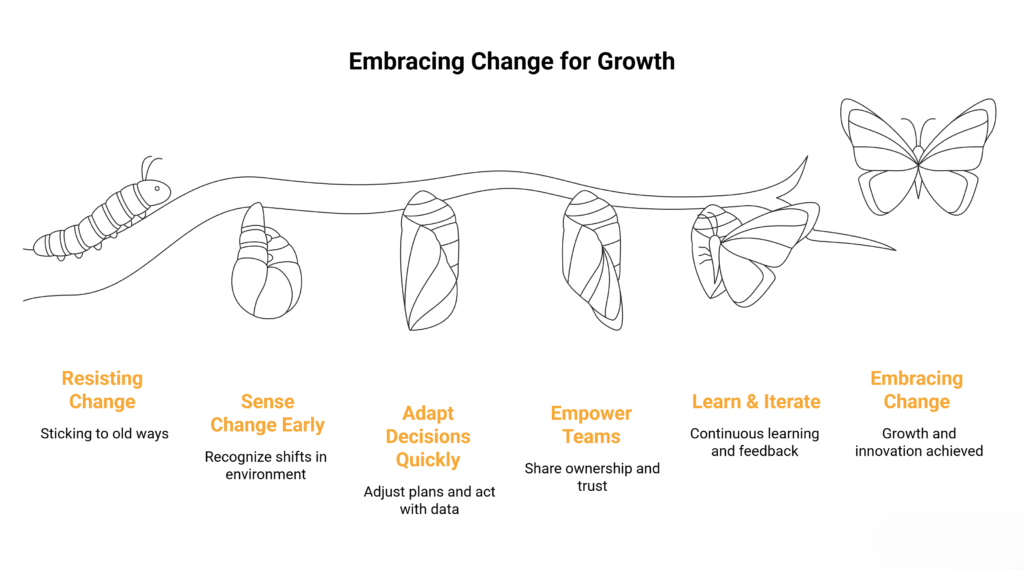
Agile leaders demonstrate leadership agility through everyday choices, not grand strategies.
- They prioritize people over process: Bureaucracy kills speed. Agile leaders strip away layers, empower teams, and build trust where decisions need to happen.
- They adapt instead of defending:
Old-school leaders defend the plan. Agile leaders adjust the plan. They treat change as input, not interruption.
- They learn continuously: Agile leaders replace “I know” with “Let’s explore,” recognising that learning is a leadership responsibility, not a phase.
- They encourage small, fast experiments: Instead of waiting for perfect answers, agile leaders test quickly, learn quickly, and improve continuously.
- They communicate with radical clarity: In fast-moving environments, silence creates confusion. Leadership agility shows up in early, open, and honest communication.
Leadership Agility Thrives on Shared Ownership
One of the most defining traits of agile leaders is their ability to shift ownership from the top to the team.
Instead of being the single decision-maker, they become enablers of collective intelligence.
In unpredictable environments, no leader can see everything – but teams can.
Leadership agility unlock this advantage by creating cultures where:
- Ideas can come from anywhere
- Decisions happen closer to the work
- Team members feel responsible for outcomes
- Success is shared, not siloed
Shared ownership turns teams into co-creators of change, not passive followers of it – and that is the true engine of agility.
The Mindset Shift Behind Leadership Agility
Leadership Agility has less to do with tools and more to do with courage – and it is often developed intentionally through a leadership development programs that challenges leaders to reflect, experiment, and evolve alongside their teams.
- the courage to delegate
- the courage to communicate openly
- the courage to let go of outdated methods
- the courage to evolve alongside your team
It’s not about controlling outcomes.
It’s about creating conditions where teams can thrive in uncertainty.
Agility Is the New Leadership Advantage
The leaders who will shape the next decade aren’t the ones with the longest experience or the most rigid strategies.
They’re the ones who can pivot with clarity, move with intention, and empower their teams to navigate the unknown with confidence.
In a world moving at unprecedented speed, Leadership Agility isn’t an optional upgrade. It’s the operating system for the future.
FAQ
Leadership agility is the ability to sense change early, make decisions with incomplete information, and empower teams to act decisively in fast-moving and uncertain environments.
Leadership agility matters because traditional leadership models struggle to keep pace with rapid change, hybrid work, and evolving market demands. Agile leaders help organisations respond faster, reduce decision bottlenecks, and maintain momentum during uncertainty.
Agile leaders demonstrate:
Openness to learning and experimentation
Willingness to delegate decision-making
Clear and frequent communication
Comfort with ambiguity
Trust in team ownership
Yes. Leadership agility can be developed through experiential learning, reflective practice, feedback loops, and environments that encourage experimentation and shared ownership rather than rigid control.
About the Author:
Anil Thomas is a certified Corporate Trainer and Founder of Mustardseed Training. He specializes in designing Leadership Development Programs, Culture Transformation Programs, and Team Building Training that help organizations build high-performing teams and strong workplace cultures. His insights on leadership, collaboration, and performance excellence have been featured in several corporate learning and development programs across India.
You can follow Anil Thomas on Youtube ,Instagram, LinkedIn
Want to know more? Let our consultants help you
Hit the ‘Click Here’ button to request for a call with us and explore how our customized solutions in leadership development, team building, and culture transformation can drive lasting impact for your organization.